
Tech Workers Must Fight Back Against Union Busting
March 19th, 2026 by Joan Wright
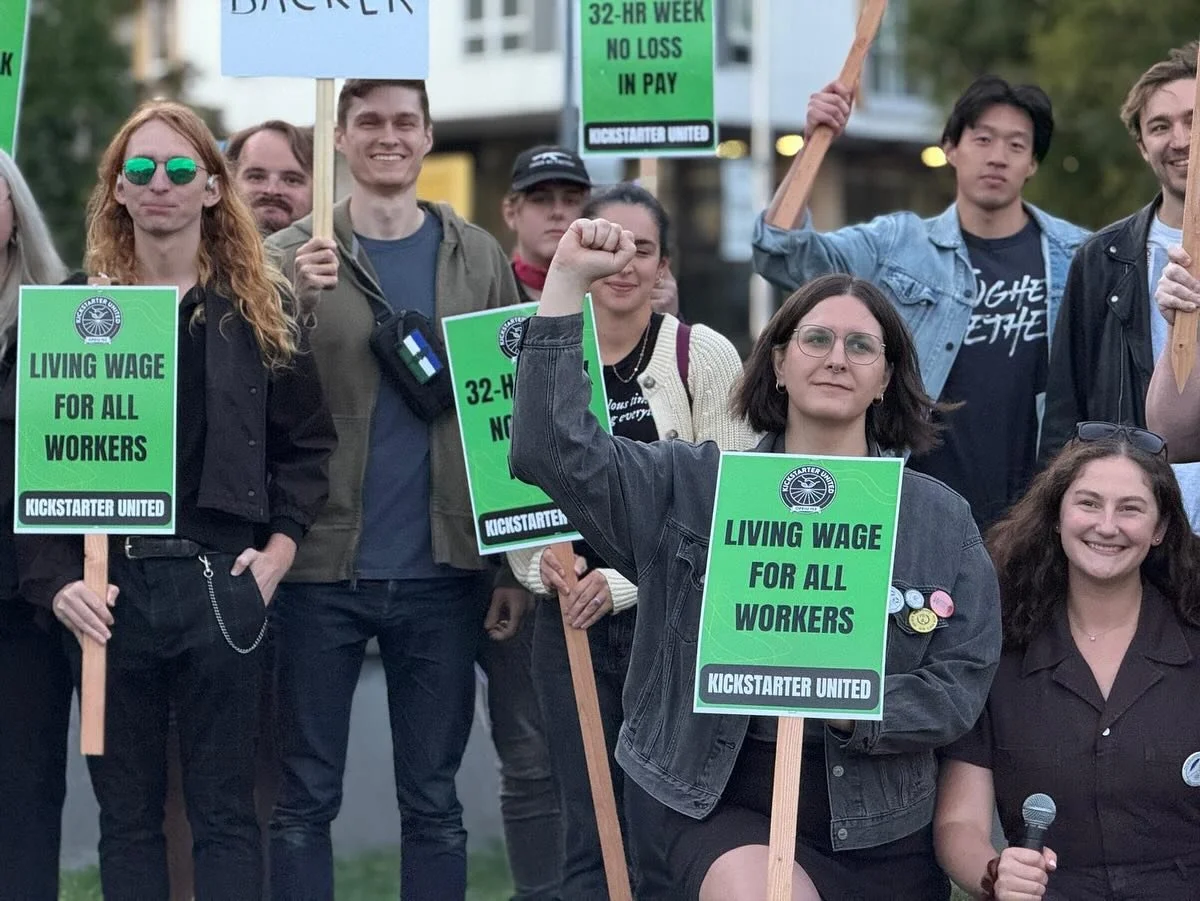
Retaliation by the bosses at tech company Kickstarter against striking workers is a reminder of why workers need to go on the offensive to fight back
Joan Wright is a tech worker, rank-and-file member of Kickstarter United OPEIU 153, and a member of Workers Strike Back.
Last fall, my union Kickstarter United — the first union in the American tech industry — carried out a historic 42-day strike. We won some real gains: protections for our four-day workweek and a salary floor tied to cost of living. It was a hard-fought battle that workers across the tech industry were watching and our union’s rank and file sacrificed a lot to see it through.
Kickstarter bosses market themselves as a public benefit corporation, claiming that the company exists for the common good rather than pure profit. Yet in response to our strike, the bosses hired the notorious union-busting law firm Littler Mendelson, the same firm used by Amazon and Starbucks to crush organizing drives. They used managers and scab workers to keep their platform operational during the strike. They even threatened to cancel our health insurance for the duration of the strike, but were forced to back off from that.
Now that our strike is over, Kickstarter bosses are retaliating against those of us who led the union’s fightback.
On February 11, Kickstarter bosses fired strike leaders. On top of that, they forced other workers out of the union by unjustifiably changing their job classification.
All of this is retaliation, plain and simple, and it is the oldest move in the capitalist playbook. Kickstarter bosses did this when workers first started unionizing in 2019 too — firing lead organizers to crush the drive before it could take hold. Now they're doing it again. The message the bosses want to send to workers is clear: if you dare to organize, go on strike, and win, we'll make you pay.
Workers are sending our message back to the bosses: We are not backing down, but instead building community solidarity among the working class to fight back. On February 27th, we hosted a Rally against Retaliation along with other unionized tech workers such as the Washington Post Tech Guild who are also facing retaliation for unionizing. We were also joined by Workers Strike Back founder Kshama Sawant, who led the way on winning the nation’s highest minimum wage and Seattle’s Amazon Tax, and who stood with our strike throughout.
We are demanding an immediate end to the retaliation and the full reinstatement of all fired and displaced workers.
Business Unionism Needs to Be Replaced By Class Struggle Unionism
The rank and file showed tremendous courage over 42 days. But our strike fell short of winning our original demands for a true 32-hour week and an $85,000 minimum salary.
The fundamental reason for this is that our union’s leadership, unfortunately, was reluctant to carry out the strike in the first place, and once the strike was underway, hesitated to use a fighting strategy in the strike. A fighting strategy would mean the union’s leadership building the strongest possible strike to cause maximum damage to the bosses’ profits.
While we were on strike, the union leadership unfortunately encouraged Kickstarter users (the company’s customers) to continue supporting and using the platform, saying publicly that the union was “not asking for a boycott”. Urging a company’s customers to continue purchasing the product runs completely counter to the purpose of a strike, which is to shut down production and sales in order to threaten the profits of the bosses and force them to concede to the strike’s demands.
Shutting down production even at conventional workplaces requires a really strong strike, with a prepared strategy by the union leadership for escalation tactics, building wide and visible community solidarity, and preventing scab workers from crossing the strike’s picket line. For example, Workers Strike Back supported a one-day strike by the workers at a coffee shop in Seattle last year. A crucial part of the success of the strike was the workers organizing to shut down the shop. Their strategy included urging the customers to stand with the strike and honor the picket line. The workers and their strike had overwhelming support from the customers, most of whom are themselves working people.
Shutting down the profits of the bosses is an even more difficult question when the workplace is remote and online, and the bosses make profits from selling an online product. Sadly, the message sent to Kickstarter’s customers only helped the company keep making profits while we were out on strike, sacrificing our wages and feeling the growing stress of bills and expenses.With enormous effort from rank-and-file workers, we organized public pickets and rallies, wrote op-eds, and got media interviews to expose the union busting practices of Kickstarter bosses. This is crucial leverage to force bosses to concede to our strike’s demands by exposing the anti-worker character of the company’s bosses. These are strong examples of a fighting strategy that helped us win the gains in our contract. However, without the solid force of hurting the Kickstarter bosses’ profits, it was not strong enough by itself to force them to concede to our major demands. The bosses also saw an opportunity to retaliate against us with impunity once the strike was over. The union leadership’s reluctance to use a fighting strategy reflects the ideas of business unionism, which tragically are what overwhelmingly dominate the American labor leadership today and have done so for decades. Business unionism is based on the false idea that workers and bosses can find common ground at the so-called bargaining table and that workers should avoid going on strike or explicitly fight against the bosses.
Business unionism treats the relationship between workers and management as cooperative, relying on legal processes and negotiations and the so-called bargaining table, rather than building real worker power. Business unionism is a rejection of the fundamental and material reality that, under capitalism, the profits of the bosses only come from robbing workers of the product of their collective labor. And, conversely, that workers can only win any substantial improvement in their living standards by wresting some of the profits from the bosses. In the absence of a strike that can shut down the profits of the bosses, or at least create a credible threat, the bosses have every incentive to simply wait the strike out. Ultimately, that is what happened in our strike.
What we need is class struggle unionism, which is a fighting approach that understands the interests of workers and the greed of bosses are fundamentally opposed, and that real leverage means shutting down production until management is forced to concede. That means boldly exposing the two-facedness of billionaires and multimillionaires who pretend to be “good guys” while screwing over workers at every opportunity. When we use every possible avenue to reveal them as just yet another union-busting, deeply exploitative company it gives us crucial leverage to force the bosses to concede.
Class struggle unionism would also mean actively building solidarity not just within a single union but across the entire labor movement, both nationally and internationally. It means organizing the unorganized — including the contract workers, disproportionately women, Black, Latino, and workers in the global south. It serves the capitalist class to always divide and pit workers against one another, and business unionist leaders end up allowing this divide-and-conquer strategy by systematically excluding oppressed and marginalized workers from the union ranks. Historically, the union movement has been at its strongest and won its biggest victories against the capitalist class when workers have successfully united as a class. For tech workers specifically, rejecting business unionism and adopting class struggle unionism also means grappling seriously with what a picket line should look like for a remote-working, distributed workforce whose product is a digital platform. These are not questions with easy answers, but they are the questions we have to answer if we want to win.
Both the Democratic and Republican Parties Serve the Billionaire Class
The retaliation my fellow workers and I are facing isn't happening in a vacuum. Under Trump, attacks on workers and unions have accelerated— from firing and de-unionizing a stunning 300,000 federal workers to gutting labor protections across the board. Tech billionaires like Marc Andreessen and Ben Horowitz, whose firm Andreessen Horowitz invested over $100 million in Kickstarter, are funneling millions into Trump's reactionary, right-wing, anti-worker agenda. The same billionaire class profiting off our labor is bankrolling the political assault on workers' rights.
But workers and oppressed people simply cannot look to the Democratic Party as an alternative. The Democratic Party, including “progressive” Democrats like Pramila Jayapal and AOC broke the railroad workers' strike in 2022. The Democratic Party presided over and funded the genocide in Gaza alongside the Republicans. Democrats have been complicit in every imperialist war, including handing over $900 billion last December for Trump’s wars this year, like the current horrific assault on Iran. Democrats voted to create ICE and have repeatedly voted to fund it. Democrats and Republicans have voted for these billions for war and racist, anti-immigrant attacks in the context of a historic cost-of-living crisis.
The Democratic and Republican parties are both parties of the billionaire class. Neither party is on our side, and we need a new party for the working class and our own independent leadership that will fight unambiguously for us against the billionaires and the multimillionaires, and against the Democratic and Republican parties that represent them. This fight is linked with the fight for class struggle unionism, with the business unionist leadership being tied at the hip to the Democratic Party.
Building the Movement We Need
We need a fighting movement independent from the parties of the billionaires. That is why I am also a member of Workers Strike Back. Workers Strike Back stood with Kickstarter United throughout our strike ,helping organize an in-person solidarity rally in Seattle and donating $1,000 to our strike fund, because we understood what was at stake not just for Kickstarter workers, but for every worker in the tech industry and beyond.
Workers Strike Back is building the campaign to elect Kshama Sawant to Congress as an independent, anti-war socialist. Kshama spoke at our virtual strike rally last September and called for exactly the class struggle approach our union needed. During her decade as a socialist city councilmember in Seattle, Kshama didn't make backroom deals with Democrats. She built mass movements that won the nation's highest minimum wage, defeated Jeff Bezos repeatedly to tax big business, and won renters' rights protections. That is the fighting strategy the labor movement needs — one that connects workplace struggles to the fight against war, deportations, and the billionaire class.
Boss retaliation only works if workers let it stand. If Kickstarter gets away with this, it sends a signal to every tech company — and every other company — that you can fire strike leaders after a strike and face no consequences. We cannot allow that.
If you want to rebuild a fighting labor movement that breaks from the two parties of big business, I urge you to join us at the Tech Workers for Kshama National Meeting on Sunday, March 29th at 2pm PT / 5pm ET. Register at kshamasawant.org/events. Together we can show the bosses that attacks on strike leaders are attacks on all of us — and that the working class will fight back. When we fight, we can win.